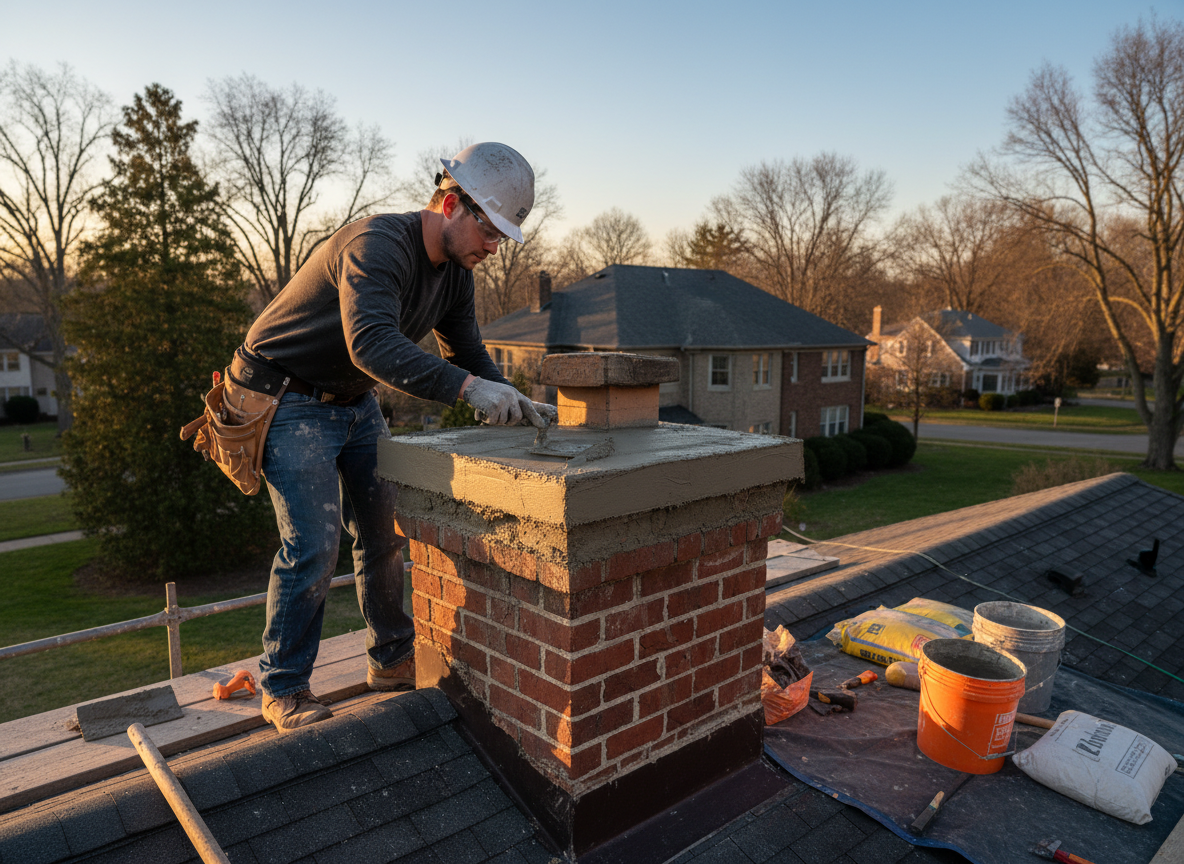
Chimney crowns in Upper Arlington take constant punishment from the humid continental climate. Freeze-thaw cycles in Franklin County push moisture through hairline cracks in the concrete cap, then expand and spall the material. Homes in neighborhoods like Arlington Ridge and Tremont often have original 1950s-1970s brick chimneys whose crowns were poured without modern drip edges or proper slope, allowing runoff to reach the flue and masonry below. We see this pattern repeatedly on streets near Northam Park and the Upper Arlington Public Library where mature trees drop debris that holds extra moisture against the crown.
Repair begins with removing loose concrete and vegetation, then installing a new cap with the correct pitch and a stainless-steel or copper flashing transition. We always check the flue tile alignment and the condition of the crown-to-flue seal because a failed crown frequently masks cracked tiles that will leak again after the first hard freeze. Work near the Upper Arlington Municipal Center or along Reed Road must account for tight lot lines and mature landscaping that limits equipment access, so most jobs are completed with scaffolding rather than lifts.
Homeowners in Worthington and Grandview Heights sometimes ask us to match the repair style used on their Upper Arlington properties because the same builders constructed many of those homes. We use a fiber-reinforced, air-entrained concrete mix formulated for Ohio winters and form the crown with a minimum two-inch overhang and a one-inch drip edge on all sides. This detail prevents water from tracking back under the crown and into the brick.
Seasonal Guidance
Schedule crown repairs in late summer or early fall before the first hard freeze. Waiting until November often means working around snow and ice, which extends the job and raises the chance of incomplete curing.
Technician insight
In Upper Arlington, the thing that catches most people out with chimney crown repair is how quickly freeze-thaw cycles in our humid continental climate destroy crowns on 1960s brick homes in Tremont and Arlington Ridge. Homeowners assume a small crack is cosmetic until water reaches the attic during a January thaw, and by then the flue tiles are often already compromised.
Crown Failure Near Northam Park
A homeowner in Tremont noticed water stains on the ceiling after a February thaw. We found the original crown had cracked along the north edge and water had entered between the flue and masonry. We removed the failed cap, installed a new sloped concrete crown with proper overhang, and renewed the flashing transition. The leaks stopped and the chimney survived the rest of the winter without further issues.
How it works
- 1
Site Inspection
We examine the crown, flashing, and flue from the roof and attic, noting any water staining or vegetation growth common on older Franklin County chimneys.
- 2
Material Removal
Loose concrete and old sealant are chipped away down to sound substrate, with debris contained to protect landscaping in dense Upper Arlington yards.
- 3
New Crown Installation
A properly sloped, fiber-reinforced cap is formed with integrated drip edges and sealed to the flue tiles using high-temperature refractory cement.
- 4
Flashing and Finish
Step flashing is renewed or added where the crown meets the roof, then the area is cleaned and the homeowner is shown the completed work from the ground.
Pricing
Upfront quotes after inspection; cost driven by roof pitch, chimney height, and extent of hidden flue damage.