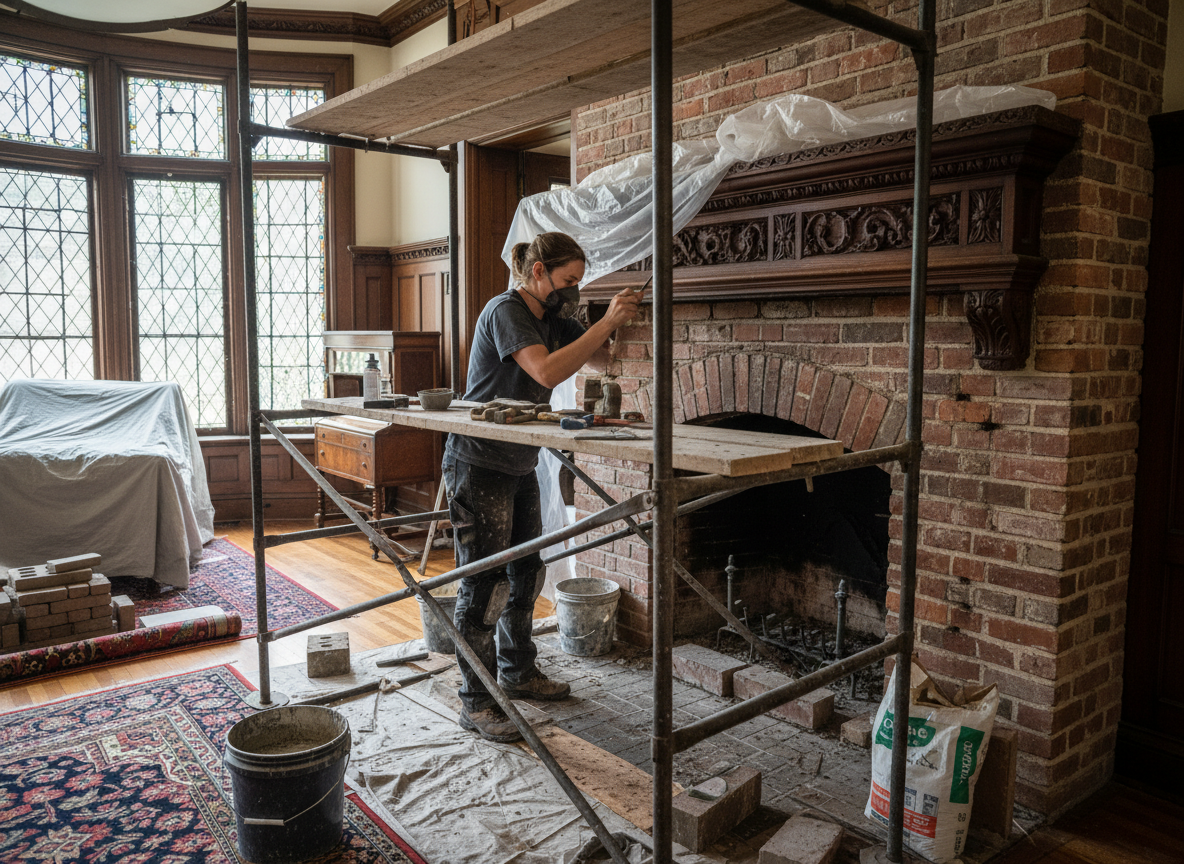
Upper Arlington homes built through the mid-20th century in neighborhoods such as Arlington Ridge, Tremont, and River Ridge often feature brick or stone fireplaces that suffer from Franklin County’s humid continental climate. Four distinct seasons bring repeated freeze-thaw cycles that crack mortar and spall firebrick, especially where chimneys rise above the roofline near Northam Park and the Upper Arlington Public Library. Restoration begins with a full inspection of the firebox, throat, and flue lining before any material replacement.
When moisture penetrates through deteriorated crowns or flashing, water migrates down to the smoke chamber and can damage the hearth extension or adjacent wood framing. Technicians at 3855 Reed Rd replace cracked firebrick with high-temperature refractory units rated for continuous 2000-degree exposure rather than standard red brick. Damper assemblies are rebuilt or swapped for cast-iron models that seal tightly against winter drafts common in this part of Franklin County.
Edge cases include homes near Grandview Heights or Worthington where additions altered chimney height or created improper draft angles. In those situations the restoration includes re-pointing exterior masonry with type-N mortar matched to the original and installing stainless-steel flue liners when the existing tile has shifted. All work follows current Franklin County residential building code requirements for clearance to combustibles.
Homeowners in River Ridge frequently request restoration before listing a property because buyers notice missing mortar and water-stained mantels during inspections. The process preserves original architectural details while updating the fireplace to meet modern safety and efficiency standards without altering the exterior appearance visible from Upper Arlington Municipal Center.
Technician insight
In Upper Arlington, the thing that catches most people out with fireplace restoration is the hidden water damage behind the firebox in homes from the 1950s and 1960s. Freeze-thaw cycles along the Scioto River corridor push moisture through the back wall of the chimney and rot the framing before anyone sees a problem on the hearth.
Cracked Firebox in Arlington Ridge Home
Homeowner noticed soot staining on the mantel after a cold snap. Inspection revealed spalled firebrick and deteriorated mortar allowing water to reach the wood framing. Refractory brick and type-N mortar were used to rebuild the firebox and smoke chamber while preserving the original stone facing. Draft tests confirmed safe operation once repairs were complete.
How it works
- 1
Initial Inspection
Examine firebox, damper, flue, and exterior masonry for cracks, spalling, and water intrusion caused by seasonal temperature swings in Upper Arlington.
- 2
Material Assessment
Identify original brick type and mortar composition used in Tremont and Arlington Ridge homes, then select compatible refractory materials.
- 3
Repair Execution
Rebuild damaged sections, repoint joints, and install liners or dampers while maintaining proper clearances required by Franklin County code.
- 4
Final Testing
Perform smoke and draft tests to confirm proper function before returning the fireplace to service.
Pricing
Pricing varies by extent of masonry damage and whether a flue liner is required; most Upper Arlington fireplace restorations fall into mid-range projects.